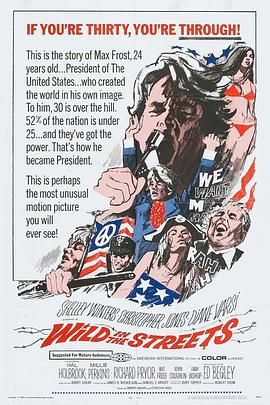
Deserves recognition as an interesting misunderstanding of the hallucination generation, 20 January 2007 Author TimothyFarrell from Worcester, MA Wild in the Streets comes from the same school of film making that spawned other attempts to connect to the counterculture such as Skidoo and Candy. The difference between this and the aforementioned films is that Wild in the Streets is reasonably clever and well-made. It isn't sympathetic to the counterculture and will likely offend those with fond memories of the time. Surprisingly, it was a big hit when released and appealed to the youth whom it ridiculed so much. Unlike The Trip and Psych-Out (two other AIP films), its not an accurate representation of the movement at all. However it does work as social satire. The direction by Barry Shear is good and makes innovative use of split screen photography. Plus, he keeps everything moving at a quick pace. In its funny moments, the film works well. In its attempts at drama, its helplessly dated and just as funny as the humorous moments. Christopher Jones underplays his role and Shelly Winters overacts. Hal Holbrook offers the best performance and Diane Varsi achieves the right note of grooviness. The script by Robert Thom has its moments, especially the ending (easily the most ingenious part of the film). Wild in the Streets isn't perfect, but deserves recognition as an interesting misunderstanding of the hallucination generation. Those into this kind of kitsch will enjoy it the most. I'd rather watch The Trip or Psych-Out however. (610) -from imd
A tapestry of vignettes, centered around a jaded concessions stand worker contemplating his future on his last day at the Royal Alamo Cinema, a closing movie theater.
After moving into a guest house in the Hollywood hills, 18 year old Sandra discovers the main house is occupied by a family of vampires and the area around is a haven for the undead.
The film chronicles the daredevil stuntman Ken Carter's quest to execute a bold stunt of launching a rocket car across the St. Lawrence River from Canada to the United States in the 1970s, facing absurd challenges along the way.
In Saint-Étienne, a semi abandoned canadian village, a young woman unravels the mystery surrounding her father's sudden death. As strange incidents multiply in her surroundings, what she discovers is even more sinister and horrifying than what she could have ever imagined.
“Rosario,” directed by Bobby Bonifacio Jr., draws on a Filipino superstition which dictates that a broken rosary must be placed in the hands of the dead; but when an unbroken rosary is mistakenly left in the hands of a deceased woman, a deadly family curse is unleashed.