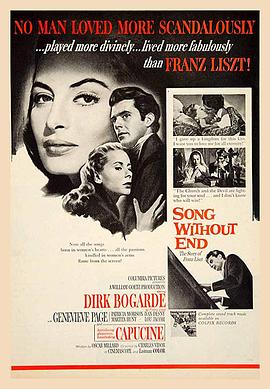
In a confused welter of artistic licence, this is the classical music biopic which makes 'Song to Remember'look like a masterpiece. Bogarde succeeds in diminishing the reputation of the musical colossus who spanned European music for most of the 19th Century. The absurdities of the plot, the sequoia-like quality of the acting and the prevalence of historical,musical and linguistic anachronisms combine to elevate this offering to the status of an A1 turkey.How a pianist of the stature of Bolet came to be mixed up in this fiasco can only be guessed at. The characterisation of Liszt fails to convey even a minute impression of his magnetic personality and the overwhelming effect that he had on not only his audiences, but also his pianistic rivals.Clara Schumann herself said that 'we toil over that which Liszt reads at sight!' Whilst the emphasis seems to focus on his romantic prowess,rather than his status as the greatest pianist of the century or,arguably, of all time, one feels,nevertheless, that this was an opportunity lost.
Фільм розповідатиме про двох «ворогів дитинства», останніх мешканців невеликого села, які лишилися жити в «сірій зоні» поблизу лінії фронту. «Мало зважаючи на воєнні події, вони намагаються створити своє мирне життя в небезпечній місцині, але все руйнується, коли в селі з’являється російський снайпер»,
When, at the beginning of Deus Irae, Father Javier stares at a crucifix, his expressions and his hands suggest that the nerves are consuming him. A flashback reveals that this priest devotes his life to visiting families that claim to have seen things that do not belong to this world and cleansing their homes from the demons that try to possess them. But, upon returning to those houses, he notices that the evidence is always destroyed. This way, he discovers that a clan is after him, and must decide whether to hide from them or join them. In times when horror cinema tends to fall into the hands of directors that seek to build narratives that are introspective and close to reality, Pedro Cristiani goes back to old-school horror, where gore and the physical experience are above any other kind of feeling. A cinema that places the camera in front of the faces of the bloodiest demons and, instead of giving logic to them, chooses to face them whatever the cost.
Didier Konings’ simmering mediaeval horror Witte Wieven explores the confluence of religion and patriarchy in an excessively puritanical Dutch village. Blamed by her community for being childless, Frieda immerses herself in prayer and ritual. When she returns unscathed from the forbidden forest surrounding the village, having evaded a lecherous butcher, she is condemned as an agent of the devil. Frieda, however, finds new faith in the dark powers that inhabit the woods.
Shot in a reduced colour palette at the edge of visibility, Konings’ gripping film constructs a convincing pre-modern society whose practices it elucidates with patience and attention. Although set in the Middle Ages, Witte Wieven displays an unmistakably contemporary spirit, crafting a feminist parable about women discovering new ways of understanding their lives and the world.
The film is inspired by the true-to-life story of the discovery of the long-lost “Opus 28” manuscript from Norwegian composer Johan Halvorsen, originally performed in 1909 by Canadian violinist Kathleen Parlow, to whom the piece was dedicated.
Campbell portrays a student who seeks to complete her thesis on Parlow by organizing a public performance of “Opus 28” from Toronto to Oslo. The cast includes Dueñas, Melanie Scheiner, Eve Duranceau, Maxim Gaudette, Rosa-Johan Uddoh, and Eileen Davies.
Debt-ridden pacifist Richard Fyre is propositioned to return to his abandoned mercenary ways by flamboyant zealot, Priest, to eliminate his international competition in exchange for a clean slate.
 剧情介绍
剧情介绍
 猜你喜欢
猜你喜欢


 热播榜
热播榜
 最近更新
最近更新
 友情链接
友情链接